

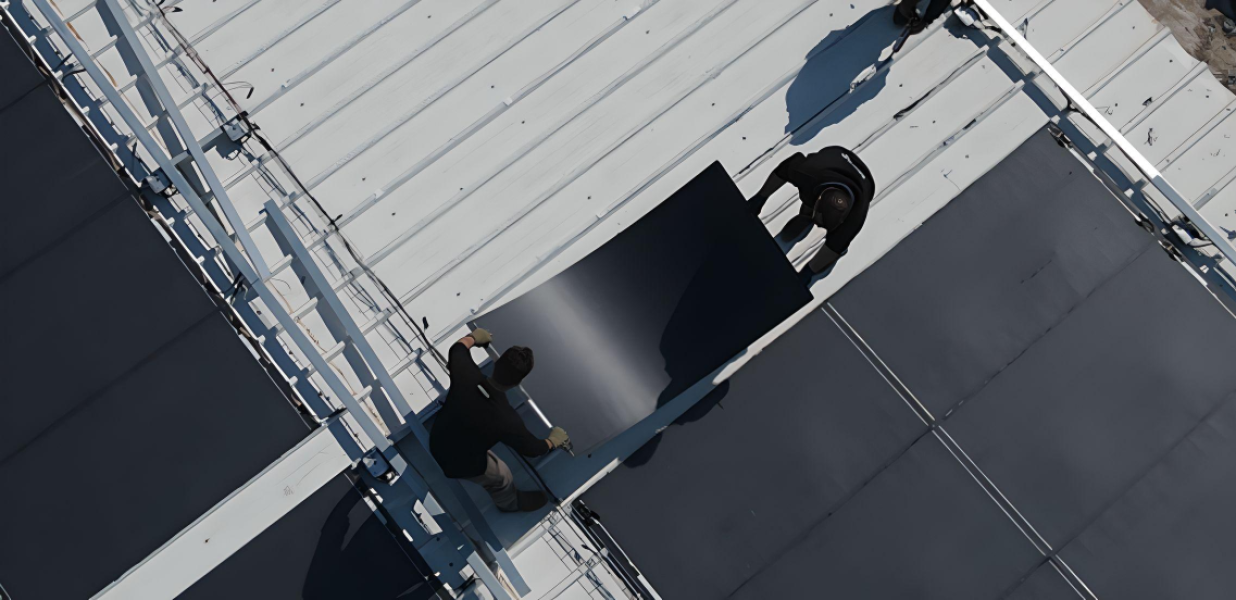
A practical guide for facility managers, building owners, and solar professionals
Many buildings are unsuitable for standard solar installations due to structural or material constraints, yet these same buildings often represent untapped potential. Rooftops with limited load-bearing capacity, non-penetrative surfaces, unusual inclinations, or curved designs are more common than they may seem. In fact, depending on the region, up to 30% to 50% of existing rooftops may fall into this category.
These include historic buildings with architectural preservation requirements, large-span structures such as sports halls and stadiums with minimal structural reserve, or commercial and industrial sheds with lightweight metal decks and minimal roof access. Often overlooked, these rooftops are becoming increasingly valuable for solar deployment as energy prices rise, incentives grow, and new ultra-lightweight solar technologies emerge that are specifically designed for such conditions.
This short guide outlines five key considerations to take into account before starting a solar project on a lightweight or structurally limited roof.
Not all lightweight roofs are built the same. In some regions, a structural survey is mandatory. In others, it’s simply a smart step that helps you avoid technical surprises and safety issues. It’s essential to evaluate both how much weight your roof can bear and how much energy you can extract from each kilogram of that weight. In other words, don’t just think in terms of watts per square meter, but also in watts per kilogram. This ratio is critical when working with constrained structures.
The material of your roof will directly influence how solar modules can be attached and how durable the system will be. Whether your rooftop is covered in metal sheets, a waterproof membrane, or synthetic insulation layers, it’s essential to understand the materials present, when they were installed, and by which manufacturer. Even small details, such as whether the membrane is glued or mechanically fixed, can affect the appropriate choice of fixation method and whether adhesive or mechanical options are feasible.
Not all lightweight modules are the same in terms of quality, resilience, and compliance. To avoid future issues, make sure the technology you select is properly certified. Look for modules that have passed international performance and safety tests, including IEC or UL standards, the French ATEC certification for building integration, as well as hail, fire, and wind resistance assessments. Fully flexible cell technologies often provide superior mechanical durability and safety on complex rooftops by eliminating the risk of microcracks, which are a common cause of rapid performance degradation and, in some cases, fire hazards.
Solar performance is not only about the module. It’s also about the setting. Before you start designing the layout, consider whether your rooftop faces the right direction, whether its inclination supports optimal energy generation, and whether there are any drainage issues or shadow-casting structures nearby. Even a high-performing, lightweight module will underperform if the roof’s slope, exposure, or layout is not well aligned. On sensitive rooftops, a smart layout can make the difference between a viable and a failed installation.
Every rooftop project should start with a clear understanding of the end goals. Will the electricity produced be consumed on-site, or will it feed into the grid? How long do you expect to operate or own the building? Would a CAPEX model, where you invest in the system directly, work better for you, or would a Power Purchase Agreement (PPA) be more suitable? Answering these questions early on ensures the project is aligned with your energy, financial, and operational goals.
Commercial buildings with lightweight roof structures can present challenges for solar installation because their available load-bearing capacity may be limited. Common examples include warehouses and industrial sheds with lightweight metal decks, buildings with sandwich or composite roof panels, large-span commercial structures, and facilities where the roof was designed with minimal structural reserve.
For these buildings, solar panels for lightweight roofs can offer an alternative to heavier conventional PV systems by reducing the additional weight placed on the structure. Solar for lightweight commercial buildings may therefore be worth considering when the roof cannot easily accommodate a conventional solar installation, particularly when a lightweight system and suitable mounting approach can reduce the need for extensive structural intervention.
However, not every lightweight roof is automatically suitable for solar. The roof material, age, condition, attachment method, existing loads, available load capacity, and local environmental conditions all need to be evaluated. Lightweight solar panels for commercial roofs can help address structural constraints, but their suitability must be determined on a project-by-project basis. A qualified structural engineer should assess the building and proposed PV system to confirm whether the roof can safely support the installation and whether any reinforcement or other structural measures are required.
Lightweight and complex roofs do not always have to prevent solar installation. With the right structural assessment, system design, and technology, some of these rooftops can become viable energy-generating assets.
If you’re planning to go solar and aren’t sure where to start, our team at Apollo is here to help. We’ll guide you through the process, starting with rooftop assessment and continuing through certified, safe installation.
Ready to explore your rooftop’s solar potential? Contact us today to speak with one of our specialists.
"*" indicates required fields
quest
fdsgsdfgd
Build Smarter Energy Today & Discover Flexible Solar Solutions with Us
"*" indicates required fields