

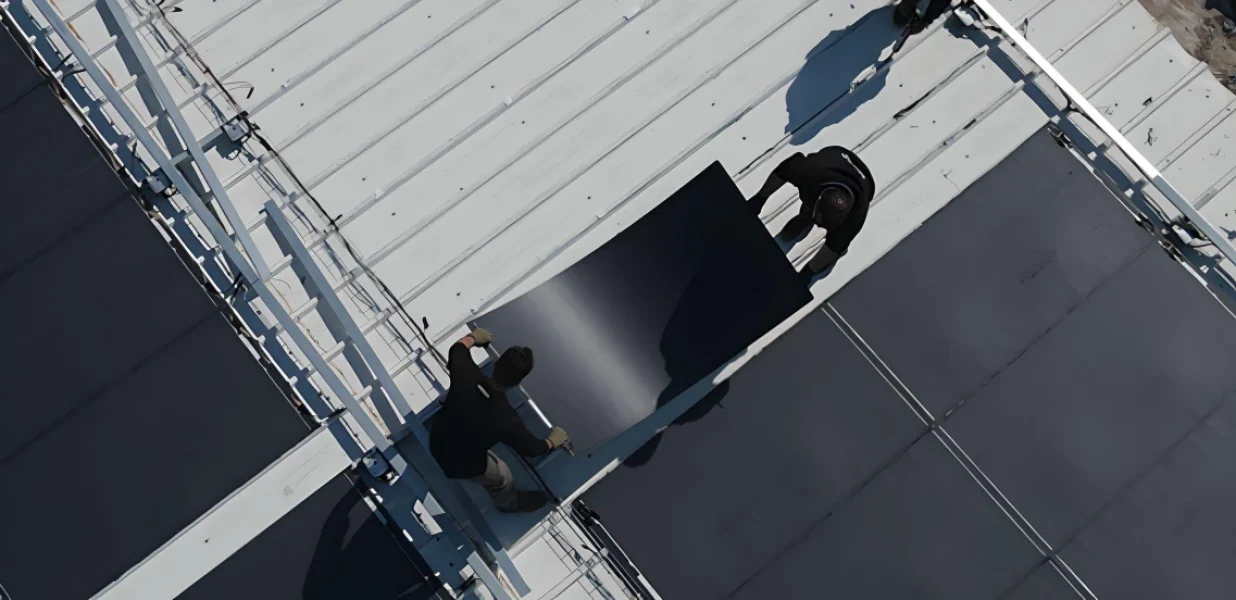
As energy prices continue to rise, businesses are increasingly investing in rooftop solar to reduce operating costs and improve long-term energy resilience. Warehouses, manufacturing plants, logistics centers, retail facilities, agricultural buildings, and sports venues all have one thing in common: large rooftop areas with the potential to generate clean electricity.
However, not every commercial roof is suitable for conventional solar installation. Structural limitations, roof materials, building age, and load capacity all play a role in determining whether a rooftop PV system is feasible.
This guide explains what rooftop PV panels are, how they work, what they cost, the structural requirements for commercial buildings, and why lightweight solar technologies are expanding solar opportunities for more rooftops than ever before.
Rooftop PV (photovoltaic) panels are solar energy systems installed on the roofs of residential, commercial, or industrial buildings to convert sunlight into electricity.
For commercial properties, rooftop PV panels allow businesses to generate renewable electricity directly where it is consumed, reducing dependence on the electrical grid and lowering long-term energy expenses.
Commercial rooftop PV systems are commonly installed on:
Warehouses
Manufacturing facilities
Logistics centers
Retail buildings
Office buildings
Agricultural structures
Sports stadiums and arenas
Distribution centers
Unlike residential systems, commercial rooftop PV installations are typically much larger, ranging from 50 kW systems for smaller businesses to multi-megawatt installations for industrial facilities.
Most commercial PV systems are designed to operate for 25–30 years while requiring relatively little maintenance throughout their lifespan.
Rooftop PV panels generate electricity through the photovoltaic effect, which converts sunlight directly into electrical energy.
The process includes several steps:
Solar cells absorb sunlight.
The cells generate direct current (DC) electricity.
An inverter converts DC electricity into alternating current (AC), which powers building operations.
Any excess electricity may be stored in battery systems, exported to the electrical grid, or credited through local net-metering programs where available.
Modern commercial rooftop PV systems also include monitoring software that allows facility managers to track energy production, identify performance issues, and optimize system efficiency over time.
Because commercial facilities often consume the most electricity during daylight hours, rooftop solar production frequently aligns with peak energy demand, maximizing self-consumption and reducing electricity purchases from the grid.
Commercial rooftop solar has become one of the fastest-growing renewable energy solutions across multiple industries.
Warehouses and Distribution Centers
Warehouses and distribution centers often feature large-span roofs covering extensive storage and handling areas. Where these roofs use lightweight construction, structural load capacity should be assessed as part of planning warehouse rooftop solar. Skylights, ventilation systems, smoke vents, and other rooftop equipment must be accounted for when designing the panel arrangement, ensuring that essential functions remain accessible and unobstructed.
For facilities operating around the clock, installation planning is equally important. Solar panels for warehouses should be positioned and installed with consideration for loading bays, internal workflows, safety zones, and ongoing maintenance access. Where the roof is suitable, low-profile, lightweight systems can help simplify installation and reduce the extent of on-site construction, potentially limiting disruption to daily operations.
Factories consume significant amounts of electricity for machinery, production lines, HVAC systems, and lighting. Rooftop solar helps offset these operating costs while improving long-term energy predictability.
Logistics centers depend on continuous movement of goods, vehicles, and personnel, making operational continuity a central consideration in any rooftop project. Distribution center solar panels and logistics center rooftop solar systems should be planned around delivery schedules, vehicle circulation, and access to critical building infrastructure. Coordinating installation phases with facility managers can help keep work areas separate from active operations and minimize interference with day-to-day activities. The installation approach and schedule should always be tailored to the specific site, with safety, access, and operational requirements addressed before work begins.
Shopping centers, supermarkets, office complexes, and commercial properties can lower operating costs while supporting corporate sustainability initiatives through rooftop solar generation.
Barns, storage facilities, packing houses, and greenhouses often have expansive roofs suitable for solar, although many lightweight agricultural structures require careful structural evaluation before installation.
Stadiums, arenas, and sports complexes have extensive roof surfaces that can generate substantial amounts of renewable electricity while supporting large daytime energy demands.
The cost of rooftop PV panels for commercial buildings depends on numerous project-specific factors, including system size, equipment selection, roof characteristics, labor costs, and local regulations.
Typical commercial system costs generally fall within these ranges:
| System Size | Typical Installed Cost* |
| 100 kW | $90,000–$140,000 |
| 500 kW | $350,000–$650,000 |
| 1 MW | $700,000–$1.2 million |
Actual costs vary by country, labor rates, permitting requirements, engineering complexity, and equipment selection.
Several factors influence the total investment:
Although commercial rooftop solar requires an upfront investment, many businesses achieve payback within approximately 4-8 years, depending on electricity prices, incentives, and energy consumption patterns.
Since commercial PV systems typically operate for 25 years or more, they can continue generating financial savings long after the initial investment has been recovered.
Energy production depends on system size, geographic location, solar irradiance, roof orientation, weather conditions, and panel efficiency.
For example:
A 100 kW commercial rooftop PV system may generate approximately 120,000–180,000 kWh per year.
A 500 kW system may produce approximately 600,000–900,000 kWh annually.
A 1 MW rooftop installation can generate well over 1 million kWh each year in favorable locations.
Actual production varies according to: Local climate, sun exposure, roof orientation , tilt angle, shading from nearby structures, panel technology and maintenance practices. Regular cleaning and routine inspections help maintain system performance throughout its lifetime.
The total area of a commercial roof does not necessarily reflect how much space is available for solar installation. HVAC equipment, skylights, ventilation systems, and other rooftop infrastructure can occupy significant portions of the surface. Shading from nearby buildings or rooftop structures may further affect where panels can be positioned and how much electricity they can generate. Safety setbacks, fire access routes, and space required for ongoing maintenance must also be incorporated into the layout from the beginning.
When usable roof space is limited, careful system design becomes especially important. Rather than simply maximizing the number of panels, the layout should prioritize areas with suitable sunlight exposure while preserving access to essential equipment and maintaining safe working clearances. Panel orientation, spacing, and placement can be optimized to make effective use of the available surface without compromising building operations.
Evaluating energy yield per available square meter is another important part of the process. This helps facility owners understand how much electricity a system can realistically generate from the usable roof area and compare different layout options. A detailed site assessment can identify opportunities that may otherwise be overlooked and support a solar design aligned with the building’s actual constraints and energy needs.
While many commercial buildings are excellent candidates for rooftop solar, some roofs cannot safely support conventional PV systems without modifications.
Several factors determine whether a roof is suitable:
Older buildings and lightweight roof structures may require structural reinforcement before traditional glass solar panels can be installed.
Roofs made from metal, membrane, or polycarbonate materials also require careful engineering evaluation to determine the most appropriate installation method. This is where lightweight solar technology can offer a significant advantage. Apollo’s flexible solar panels weigh approximately 80% less than conventional glass panels and are bonded directly to the roof surface rather than mounted on heavy racking systems. By reducing structural load and simplifying installation, they make it possible to deploy rooftop PV systems on many commercial roofs where traditional solar solutions may be impractical.
Before any commercial rooftop PV installation begins, structural engineers typically evaluate the building to ensure it can safely support the solar system throughout its operational life.
A structural assessment generally includes:
Roof load capacity
Dead load and live load calculations
Wind uplift resistance
Roof age and condition
Waterproofing systems
Drainage design
Roof attachment methods
Building code compliance
These assessments help determine whether structural reinforcement is necessary before installation.
In many commercial projects, reducing the weight of the solar system can significantly simplify engineering requirements.
Although rooftop solar offers significant benefits, several practical limitations should be considered during project planning.
Roof Age
Installing solar on a roof nearing the end of its service life may require roof replacement before installation.
Shading
Nearby buildings, HVAC equipment, trees, or other rooftop obstructions can reduce overall system performance.
Structural Constraints
Some buildings simply cannot support heavy conventional solar systems without extensive structural upgrades.
Roof Maintenance Access
Solar layouts should allow sufficient access for future roof inspections and maintenance.
Utility Interconnection
Connecting large commercial systems to the electrical grid may require utility approvals and infrastructure upgrades, depending on local regulations.
Why Lightweight Rooftop PV Systems Are Expanding Commercial Solar
One of the biggest challenges facing commercial rooftop solar is structural weight.
Traditional glass PV systems, together with mounting structures and ballast, can add 20–30 kg per square meter to a roof. For many aging or lightweight commercial buildings, this additional load can make solar projects financially challenging or even impossible without structural reinforcement.
Lightweight rooftop PV systems are helping overcome these limitations.
By reducing overall roof load, lightweight solar technologies enable installations on buildings that previously could not accommodate conventional solar systems.
Apollo Power develops lightweight, flexible rooftop PV technology specifically for commercial and industrial applications where structural constraints are a major consideration.
Compared with conventional systems, Apollo’s technology offers several advantages:
Approximately 80% lower system weight
Compatibility with metal, flat, curved, and polycarbonate roofs
Reduced structural impact on the building
Faster installation with fewer structural modifications
Resistance to vibration and demanding environmental conditions
Compliance with international IEC and UL standards
Because the panels sit closer to the roof surface, they can also reduce wind loads while maintaining a lower visual profile than traditional mounted systems.
| Feature | Lightweight Flexible PV | Traditional Glass PV |
| Weight | Approximately 2.9 kg/m² | 20–30 kg/m² |
| Installation | Simplified installation with reduced labor | Heavy mounting systems required |
| Roof Compatibility | Metal, flat, curved, membrane, polycarbonate | Limited by roof structure |
| Structural Impact | Low | Higher |
| Wind Profile | Low-profile installation | Elevated mounting structures |
Commercial rooftop solar continues to evolve as businesses seek solutions that balance energy production, structural safety, and long-term return on investment.
Advances in lightweight PV technologies are expanding access to buildings that were once considered unsuitable for solar installations, allowing more companies to benefit from on-site renewable energy generation.
Whether planning a new facility or upgrading an existing commercial building, selecting a rooftop PV system should involve careful consideration of structural requirements, energy goals, installation costs, and long-term operational performance.
By combining thoughtful engineering with modern solar technologies, businesses can maximize rooftop space while improving energy efficiency, reducing electricity costs, and supporting long-term sustainability objectives.
"*" indicates required fields
What are rooftop PV panels?
Rooftop PV panels are photovoltaic systems installed on the roofs of buildings to convert sunlight into electricity. They allow commercial facilities to generate renewable energy on-site and reduce reliance on grid electricity.
How do rooftop PV panels work?
Rooftop PV panels absorb sunlight through photovoltaic cells, producing direct current (DC) electricity. An inverter converts the DC electricity into alternating current (AC), which powers the building. Excess electricity may be stored in batteries or exported to the electrical grid.
How much do rooftop PV panels cost for commercial buildings?
Costs vary depending on system size, roof characteristics, engineering requirements, and equipment selection. Commercial rooftop PV systems can range from under $100,000 for smaller installations to more than $1 million for large industrial projects.
Can all commercial roofs support PV panels?
Roof load capacity, building age, roof condition, material type, and wind resistance all influence whether a commercial roof can safely support a PV system. Some buildings require structural reinforcement, while lightweight systems like Apollo’s can reduce these challenges and be mounted where conventional solar cannot.
What are the structural requirements for rooftop PV systems?
Structural evaluations typically assess roof load capacity, wind uplift resistance, waterproofing, drainage, roof condition, and compliance with local building codes before installation begins.
How long does it take to install rooftop solar panels?
The physical installation can take anywhere from a few days to several weeks, depending on the size and complexity of the project. Engineering, permitting, and procurement may require additional time before installation starts.
What affects the efficiency of rooftop PV panels?
The efficiency of rooftop PV panels is influenced by solar irradiance, roof orientation, tilt angle, shading, temperature, panel technology, maintenance, and the quality of the overall system design.
Build Smarter Energy Today & Discover Flexible Solar Solutions with Us
"*" indicates required fields