

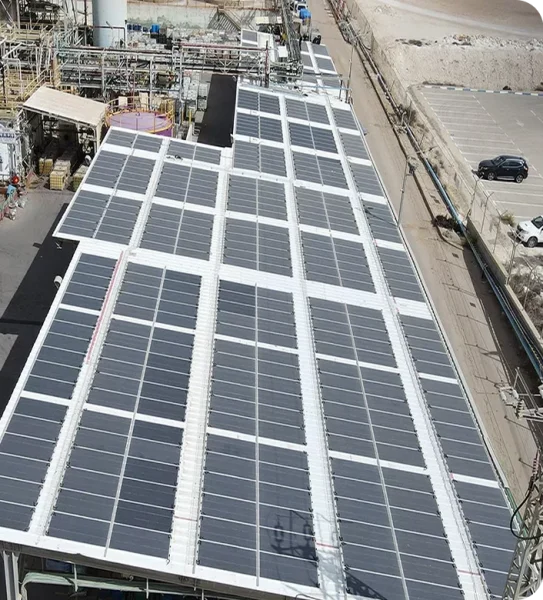
Across Europe and the United States, companies are turning their rooftops into clean-energy assets. From logistics centers to high-rise offices, solar rooftops are becoming one of the smartest ways to cut energy costs and carbon emissions.
But there’s one common obstacle that keeps many buildings from joining the solar revolution: load limitations.
A load-limited roof simply means the structure cannot support heavy equipment, such as conventional photovoltaic roof panels, without compromising safety. These limitations are more common than you might think.
In fact, around 30–40% of commercial and industrial buildings were never designed to hold the additional weight of standard solar systems, which typically add 18–25 kg per square meter.
When the load availability of a roof falls between 4 and 18 kg/sqm, conventional solar panels are usually too heavy to install safely or efficiently. That’s precisely where lightweight photovoltaic roof panels, like Apollo Power’s, can make a difference, potentially allowing solar energy generation on roofs that may not support conventional PV systems.
Load limitations can be found in any structure, from a private house to office buildings and even retail stores and distribution centers. However, certain types of roofs are naturally more prone to weight constraints. Examples include:
If your rooftop is constructed from metal sheets, sandwich panels, polycarbonate, waterproofing membranes, or composite layers, there’s a good chance it has limited load capacity.
Even newly built, energy-efficient structures can be structurally optimized and therefore leave little margin for heavy rooftop installations.
However, the only way to accurately confirm a roof’s load availability is through a structural survey or static report conducted by a qualified structural engineer.
Before installing solar panels on office buildings or other commercial assets, it’s important to follow a few essential steps:
Taking these steps early prevents costly redesigns, avoids delays, and keeps the project on track from concept to commissioning.
For commercial buildings with limited structural capacity, lightweight solar can open up possibilities that heavier conventional systems may not. Understanding the commercial solar roof load is the first step: the available capacity of the roof needs to be compared with the complete proposed PV system, including the panels, mounting method, electrical equipment, and other applicable loads.
Solar panels for weight-restricted roofs can be particularly relevant where minimizing additional dead load is important. In some cases, low-load roof solar or load-limited roof solar may allow a project to move forward with a lightweight system where a conventional installation would require further structural work. This can make commercial solar without roof reinforcement or the use of solar panels without roof reinforcement possible on certain buildings.
However, lightweight panels do not automatically mean that reinforcement is unnecessary. The roof structure, existing loads, attachment or mounting method, and local conditions must all be assessed. Therefore, solar installation without structural reinforcement should only be considered after a qualified structural engineer has evaluated the building’s actual load-bearing capacity and the proposed solar system. The final decision depends on the specific roof and project requirements.
Lightweight solar technology is redefining what it means for a building to be solar-ready.
When a roof’s load availability falls within the 4–18 kg/sqm range, Apollo Power’s fully flexible solar modules offer a unique solution.
Weighing just 2.9 kg/sqm, they may enable safe and efficient solar installations on roofs that cannot accommodate heavier conventional systems, potentially reducing or eliminating the need for structural reinforcement where approved by a qualified structural engineer.
The result? More rooftop area available for clean energy generation, shorter installation times, and safer long-term performance.
For solar power for office buildings, lightweight systems also make it easier to comply with local building codes, maintain visual harmony, and expand solar adoption in densely built urban areas.
If you’re exploring solar panels for office buildings or other load-limited structures, Apollo Power’s fully flexible, ultra-light PV technology can help you harness solar energy safely and efficiently.
Contact our team to assess your rooftop’s potential and discover how much solar power your building can safely generate.
"*" indicates required fields
Build Smarter Energy Today & Discover Flexible Solar Solutions with Us
"*" indicates required fields